
The SEC’s Risk Alert on Conflicts of Interest and Fee Billing: A Practical Response

By Elizabeth Cope, CPA, CSCP, CIPM, CEO & Lead Consultant
Background
In the recently published Risk Alert, the SEC summarizes their observations of RIA disclosures, policies and applications on economic conflicts of interest, and fee arrangements. These observations are not particularly new. As a fiduciary, an advisor has an obligation to either avoid or mitigate conflicts of interest through full and fair disclosures. However, what continues to remain challenging for many RIAs is building a process to properly identify conflicts of interest, discerning when they should be disclosed, and maintaining proper controls to ensure fee billing practices remain aligned with the advisory agreements, disclosures, and a firm’s actual operations.
Rather than summarize what this most recent Risk Alert identified, we wanted to provide some practical takeaways to help you continue building out your firm’s compliance systems specifically for conflicts and fee billing arrangements.
Building a Conflicts Inventory
One takeaway is that many firms don't have a single place where all of their economic conflicts live, which means they can't systematically confirm that each one is (a) identified, (b) evaluated, and (c) accurately disclosed. Here are some steps to start consolidating this information:
Follow the Money
A great starting place is looking at revenue sources.
How does the firm make money?
How do the owners make money?
How do your advisors and portfolio managers make money?
Are there any incentives tied to your recommendations, account types, custodians, products or services?
To help answer these questions, you could run a general ledger for the firm, review the cash flow, and then interview key personnel. For a firm that is larger or more complicated, create a risk committee that meets periodically to discuss new and existing developments to further identify conflicts.
Document the Trail
After conducting your research, create a matrix to identify all the conflicts. Your conflict inventory matrix could include the following in a list, table, or Excel format. We used some of the specific conflicts identified in the risk alert.
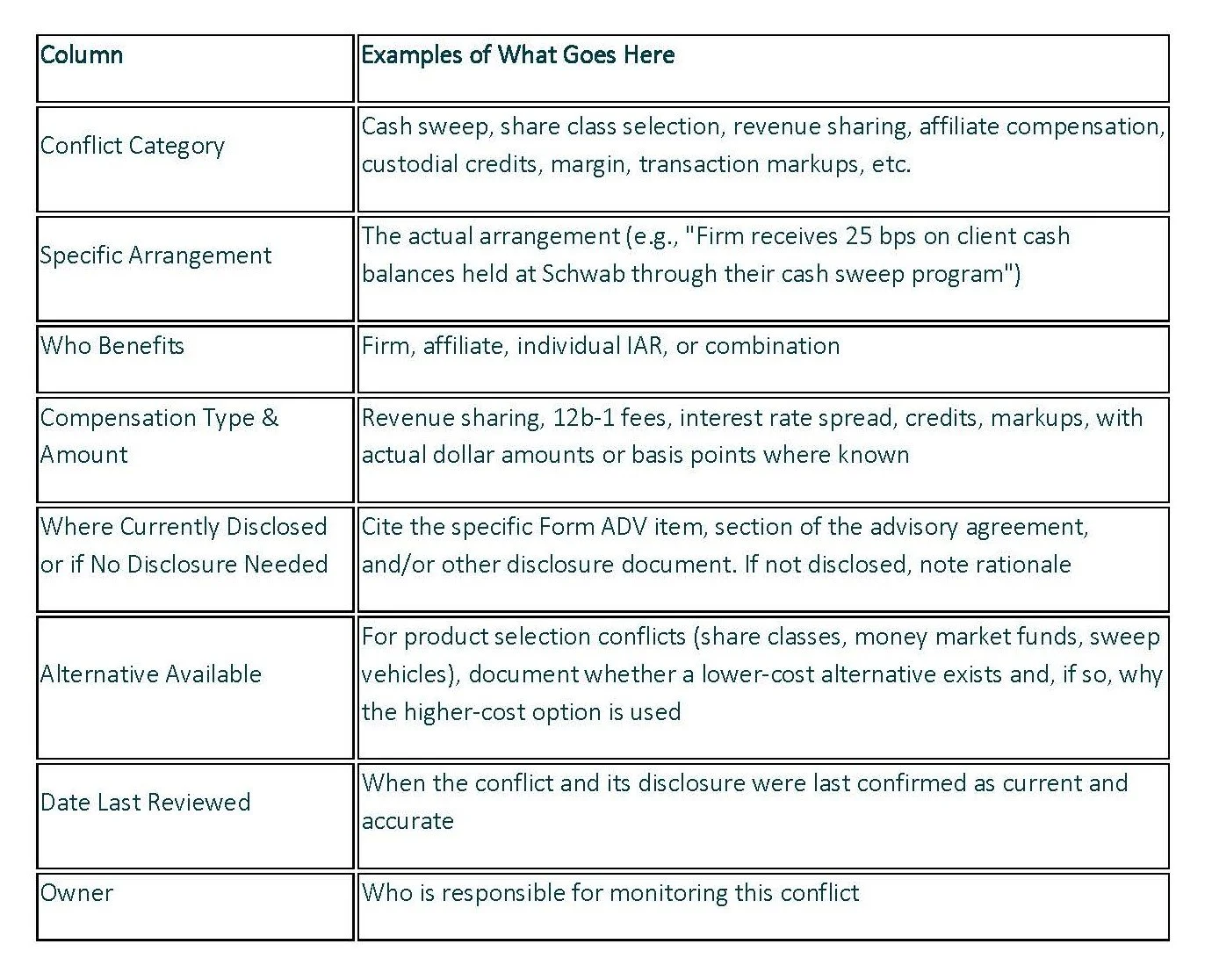
The matrix isn’t just a disclosure checklist. It’s a decision tree. Every conflict gets an entry. Every entry gets an outcome (eliminated, mitigated and disclosed, disclosed, or documented as not requiring disclosure). An examiner looking at a complete, well-reasoned inventory with documented determinations for each entry is going to have a very different reaction than one looking at firm that simply never identified the conflict in the first place.
To Disclose or Not to Disclose
The fiduciary interpretation gives advisers three paths for any identified conflict: eliminate it, mitigate it, or disclose it and obtain informed consent. Disclosure is the default, but it's not the only compliant outcome. The key is that whatever path your firm takes, the reasoning is documented and defensible.
Here's a decision tree of questions you could work through for each conflict identified in the matrix.
Has the conflict been eliminated? Great, nothing further to do.
Has the conflict been mitigated, and if so, does a residual conflict remain? Mitigation does not eliminate the obligation to evaluate disclosure, but it can change the scope:
a. What specific steps has the firm taken to mitigate the conflict?
b. After mitigation, does any residual income benefit flow to the firm?
c. After mitigation, could the remaining conflict still incentivize your firm to consciously or unconsciously provide advice that is not disinterested? If this is a Yes, I would argue disclosures are warranted.
Is the conflict material to the client’s decision-making? Take the time to put yourself in the shoes of the investor and ask yourself:
a. Would a reasonable client consider this information important in deciding whether or not to engage our firm?
b. Does this arrangement create an incentive to recommend a specific product, service or account type over another?
c. What is the magnitude of the benefit relative to the Firm’s overall revenue?
d. And then my favorite, if you are the investor would you want to know this fact?
Even if you determined the conflict was immaterial, would a reasonable examiner still expect to see disclosures? Examining risk alerts, enforcement cases and hearing about results from exams can help your firm gauge the appropriate answer. Experience helps here, so if you don’t have it, find it either with lawyers, consultants, roundtables, talk groups, etc. There is no special award for being a lone ranger – find your compliance tribe.
Finally, if you determine disclosures are not required, what documentation supports your decision? And then don’t forget to actually document the rationale.
Circle Back
Don’t let this documented exercise sit on the top shelf of your hall closet. Make sure you regularly review and update as necessary. Further, time-stamp the review, even if no changes were made to support the regular oversight.
Building a Fee Testing Program
To simplify the findings in the Risk Alert, the SEC generally observed that billing was inconsistent with what the firms agreed to charge and fees were charged for services not actually provided. Both stem from one root cause of not systematically testing and reviewing the billing process and disclosures.
Identify the Correct Methodology
Before you start your review, make sure you have a good handle on “what” the methodology should be. This includes details on billing frequency and timing, billable asset definition, the fee schedule(s), householding rules, pro-ration methodology for deposits and withdrawals, refund calculation for termed clients on advanced billing, negotiated fee arrangements, and rebates and offsets. This should be clearly outlined in your firm’s compliance manual and cross-referenced to your ADV, advisory agreements, and any other client specific side letters for consistency.
Let the Testing Begin
Develop a cadence (quarterly/annually). Pick a sample size (a meaningful sample size is 10-15% of accounts). For each sample account, compare the value used for billing against a reported third party, if available, then manually recalculate the fee using the fee methodology and schedule(s) identified and compare this to what was actually billed. Below are some things to consider based on the Risk Alert when pulling your samples and conducting your testing:
High-Risk Account Type: Accounts with negotiated fees
What to Test: Is the negotiated rate actually being applied?
Why (SEC Observation): Firms applied incorrect fee rates or failed to apply reduced rates.
High-Risk Account Type: “Householded” accounts
What to Test: Are all related accounts properly linked and breakpoints correctly applied?
Why (SEC Observation): Firms failed to household accounts for fee rate breakpoints.
High-Risk Account Type: Account with excluded asset types
What to Test: Are excluded assets (cash, fixed income, initial inflows) actually excluded from the fee base?
Why (SEC Observation): Firms charged fees on holdings specifically excluded per advisory agreements.
High-Risk Account Type: Mid-period deposits/withdrawals
What to Test: Is proration being applied consistent with the agreement and disclosures?
Why (SEC Observation): Firms prorated fees when agreements didn’t provide for proration (or vice versa).
High-Risk Account Type: Recently terminated accounts
What to Test: Were fees stopped on the termination date? Were prepaid fees refunded?
Why (SEC Observation): Firms continued billing terminated accounts and failed to refund prepaid fees.
High-Risk Account Type: Accounts where an advisor departed
What to Test: Were accounts reassigned? Are fees still being charged?
Why (SEC Observation): Firms charged fees on accounts receiving no advisory services after personnel departed.
High-Risk Account Type: Accounts with transaction fee rebate commitments
What to Test: Are rebates actually being applied?
Why (SEC Observation): Firms failed to rebate transaction fees despite agreements promising no such fees.
High-Risk Account Type: Internal transfers
What to Test: Did the transfer trigger duplicative billing?
Why (SEC Observation): Firms billed clients more than once for the same services after internal asset transfers.
When Necessary, Take Remedial Action
Flag all variances and investigate even if they seem small. If you find repeated issues, identify the core of those issues (i.e. the billing software is wrong, the agreements are wrong, etc.) and correct the issue at the root cause. If the issue is the people, hold a training session. If you overbilled clients, immediately refund fees and determine whether applying interest makes sense given the length of time since the overpayment.
Document
If there is no documentation, then in the eyes of the SEC it never occurred. Keep solid records supporting your billing process, testing and remedial action, if any taken.
The Refund Trap
I do want to point out that one of the concerns was advisors not refunding fees because the client didn’t provide a “written” refund request. Don’t wait for this request. If your agreement says you provide refunds upon termination, then provide the refund upon termination.
Conclusion
These are elements of a robust compliance program to assist the firm with its obligations under Rule 206(4)-7 to maintain an annual review, so there was nothing really new, although, in this risk alert the SEC was very specific of matters they identified. Use this as an opportunity to re-visit your program and strengthen any areas of weakness.
If you’re wanting assistance or a second set of eyes on your compliance program, we would love to chat and see if one of our service offerings would help you strengthen your compliance program.