
Building a Strong Compliance Foundation For New SEC-Registered Advisers

By Elizabeth Cope, CPA, CSCP, CIPM, CEO & Lead Consultant
Background
Whether you are leaving a brokerage firm to become independent, transitioning from State to SEC registration or simply starting from scratch, you have to consider and properly plan the infrastructure necessary to meet the compliance requirements as an investment advisor registered with the SEC.
Registration with the SEC
To be able to register with the SEC you need to meet one of the following requirements:
You have $100 million in assets under management, unless your place of business is in New York, in which case you would transition or apply for SEC registration when you have more than $25 million in assets under management. It’s not explicitly required to register with the SEC until you have $110 million in assets under management, with the option to register at $100 million.
You are the adviser or sub-advisor to a mutual fund or ETF, regardless of assets under management.
You no longer meet the exemption of a foreign private adviser.
You have to register in more than 15 states and can meet the multi-state advisor’s requirement.
You are an Internet Advisor.
You provide Pension Consulting services.
You are considered a related advisor.
Items 3-7 are defined within Rule 203A-2. It is critical to review and understand the requirements that must be met for each before you proceed.
Generally, if you do not meet one of the options listed above then you will register with the proper state securities division, which is based on your place of business and the residency of your clients, with each state having their own requirements. In most cases, the majority require registration in their state prior to taking on the 6th client.
Top Ten Tips
Starting an independent advisory firm is an exciting milestone, but it comes with significant regulatory responsibilities. Many advisers focus on attracting clients and building their investment process, only to discover that compliance infrastructure requires just as much attention. Establishing the right foundation from day one can help avoid costly mistakes, regulatory deficiencies, and operational headaches as the firm grows.
If you don’t have the expertise in-house to manage the Firm’s compliance, start by finding the appropriate support. It’s so much easier to establish a solid program in the beginning than to play catch up later.
Here are our Top 10 Tips, in no particular order of importance:
Understand your registration obligations: Do you register with the SEC or state? Do you have individuals that meet the definition of an Investment Advisor Representative and if so, which states do they need to register in? What states do you need to notice file in?
Invest in compliance support early: Whether in-house or outsourced, get the right people in the right seats of the bus to properly support the compliance functions.
Customize your policies and procedures: This is one of the areas where we see the most deficiencies from exams. It’s important that you tailor them to your firm’s operations.
Don’t underestimate the marketing rule: This is the other area where we see the most deficiencies from exams. Make sure your materials, website and social media sites comply with the rule’s requirements. This also includes any individuals/entities paid to solicit clients for a referral fee
Evaluate whether you have Custody: Often, advisers don’t realize they have custody because they think it only entails physical custody. Common areas to consider are standing letters of authorization, receipt of checks from third parties that are for your clients, acting as trustee on advisory client accounts, having client log-in credentials, and/or advising a private fund in which you or a related party are also the general partner/manager. Of course there are more situations, so an exercise to understand the services, accesses and practices while considering the facts and circumstances is necessary.
Build your compliance calendar: Establish a system to track and monitor your firm’s ongoing testing, review, disclosure reporting and filing requirements. A well-maintained calendar helps ensure critical deadlines are not missed.
Establish a personal trading monitoring process: There are many software solutions available that you can use to establish data fees for brokerage accounts, monitor the accounts, and distribute and maintain affirmations. We always recommend implementing one of these solutions once your firm has more than ten employees as it can be a cumbersome process if collecting and reviewing manually. If not using software, determine a method that allows you to timely collect and review personal trade information.
Archive electronic communications: Identify what types of electronic communications will be permitted and if permitted establish the proper systems to archive and monitor these communications.
Train employees: Training is important initially and on an ongoing basis. Your employees are your biggest risk. If they don’t understand and comply with the rules and regulations as applicable in the firm’s policies and procedures, it could be detrimental to your firm. Your employees need constant reminding to ensure a strong culture of compliance at your firm.
Conduct a meaningful annual review: Conduct a risk based annual review that tests and reviews the functions of the firm to ensure your policies and procedures are followed and reasonably designed. We highly recommend creating a system where you are reviewing/testing throughout the year rather than just one time a year. This can help prevent violations going for long periods.
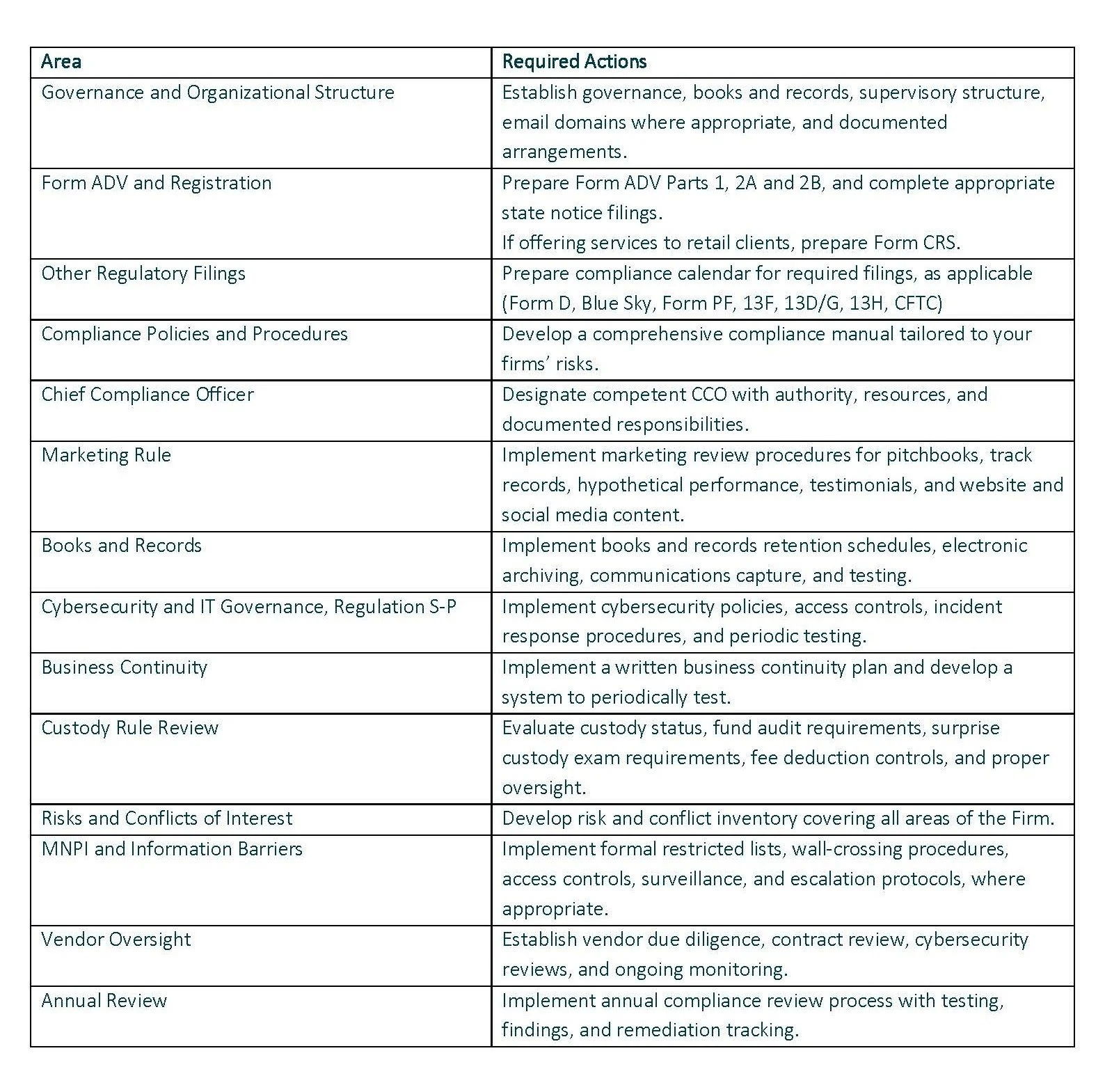
Summary of Key Areas
Below, please find a table summarizing the key areas to establish an effective compliance program.
Conclusion
When launching an independent advisory firm, you want to be exam ready from day one. You should assume that you will be examined at any moment and expect that every policy, disclosure, marketing piece, record, or client communication could be reviewed. Further, your compliance program should evolve with the business and the regulatory environment. Sign up to receive alerts from the SEC on areas such as risks alerts and new rule making. As the business evolves with the launch of new products, service lines, etc., re-visit your current program and make the necessary changes.
New registrants who invest time in developing tailored policies and procedures, maintaining accurate disclosures, implementing effective oversight processes, and creating a culture of compliance are better positioned to avoid common regulatory pitfalls. While compliance can seem overwhelming at first, establishing the right infrastructure from the beginning is significantly easier than correcting deficiencies later.
By approaching compliance as a core business function rather than a regulatory burden, you can build a firm that is not only compliant, but also operationally efficient, scalable, and prepared for future growth.
At SEC Compliance Solutions, we work with advisers at every stage of their development to help build practical, risk-based compliance programs designed to meet regulatory expectations while supporting the firm's long-term objectives. Click here to schedule a call with one of our lead consultants.